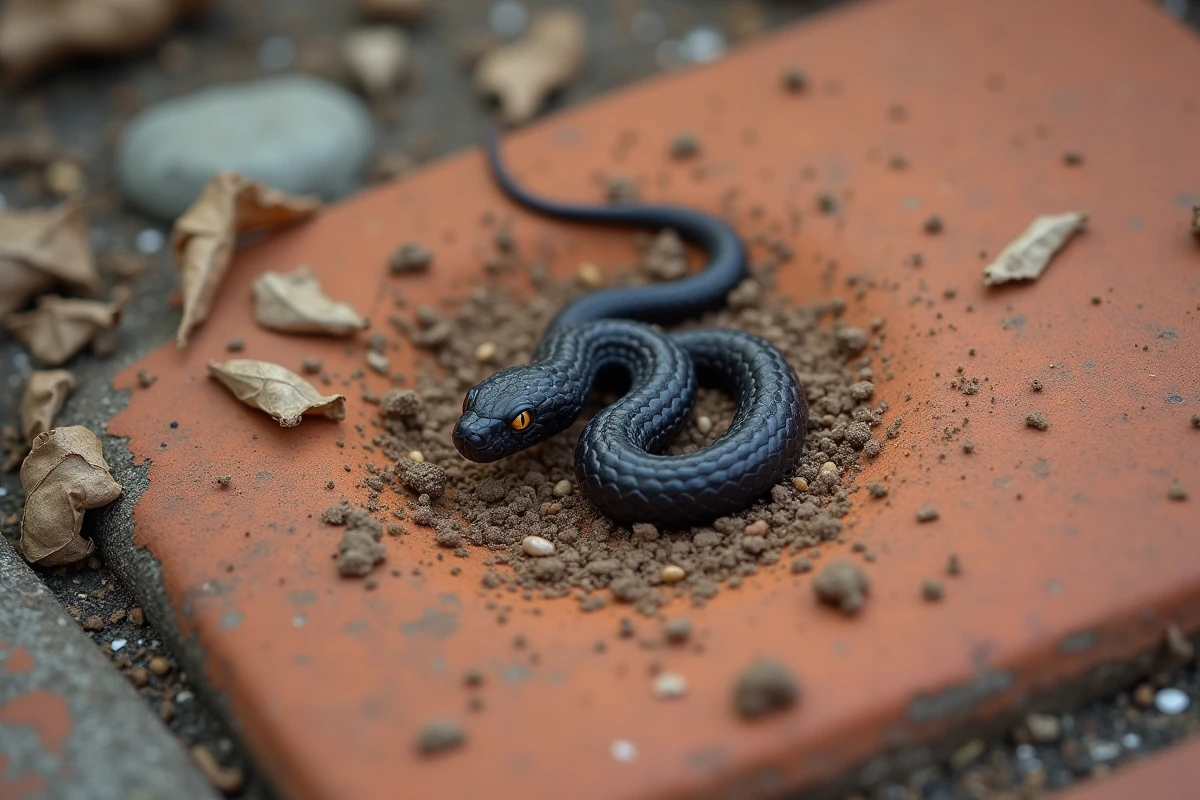
Finding a small dark and whitish lump at the foot of a wall or near the compost raises a direct question: is it a snake droppings or that of another animal? Snake droppings have specific characteristics that allow them to be distinguished from those of mammals or birds, provided you know where to look and what to compare.
Musk odor and white urates: the two markers to check first
Most guides focus on the shape of the droppings, but a criterion often overlooked can clarify the doubt more quickly: the smell. Snake droppings emit a much stronger and muskier odor than those of similarly sized mammals (rodents, hedgehogs). This olfactory difference, highlighted by several herpetological centers in recent years, helps to decide when the shape alone remains ambiguous.
The second marker to look for is the presence of urates, a white or yellowish mass attached to the droppings. Reptiles do not urinate like mammals: their nitrogenous waste is eliminated in solid form, mixed with feces. A typical snake dropping therefore consists of a dark part (fecal matter) and a whitish part (urate), often fused into a single elongated lump.
If you find a dropping without visible urate, field reports vary on this point. The urate may dissolve in the rain or detach, making visual identification alone less reliable. Combining smell, presence of urate, and location remains the most solid method.
To learn everything about snake droppings and their role as indicators of biodiversity in the garden, the composition of these droppings deserves close observation.
Snake droppings or mammal excrement: concrete distinguishing criteria
The most frequent confusion concerns the droppings of hedgehogs, rats, or cats. Here are the criteria that allow you to separate snake droppings from the most common droppings in the garden:
- The shape: a snake dropping is elongated, often irregular, with rounded or slightly tapered ends. Rat droppings are more cylindrical and uniform, while hedgehog droppings contain visible insect fragments.
- The color: dark brown to black for the fecal part, with this characteristic white portion. Cat or hedgehog droppings are uniformly colored, without a distinct white area.
- The content: by observing the dropping closely (a stick is enough to open it), you may find fish scales, small rodent bone fragments, or amphibian remains. The presence of small bones or ingested hair confirms a reptilian predator, as snakes swallow their prey whole.
- The location: snakes deposit their droppings where they move or bask, typically against a south-facing wall, under a sheet metal, near a woodpile, or around a composter.
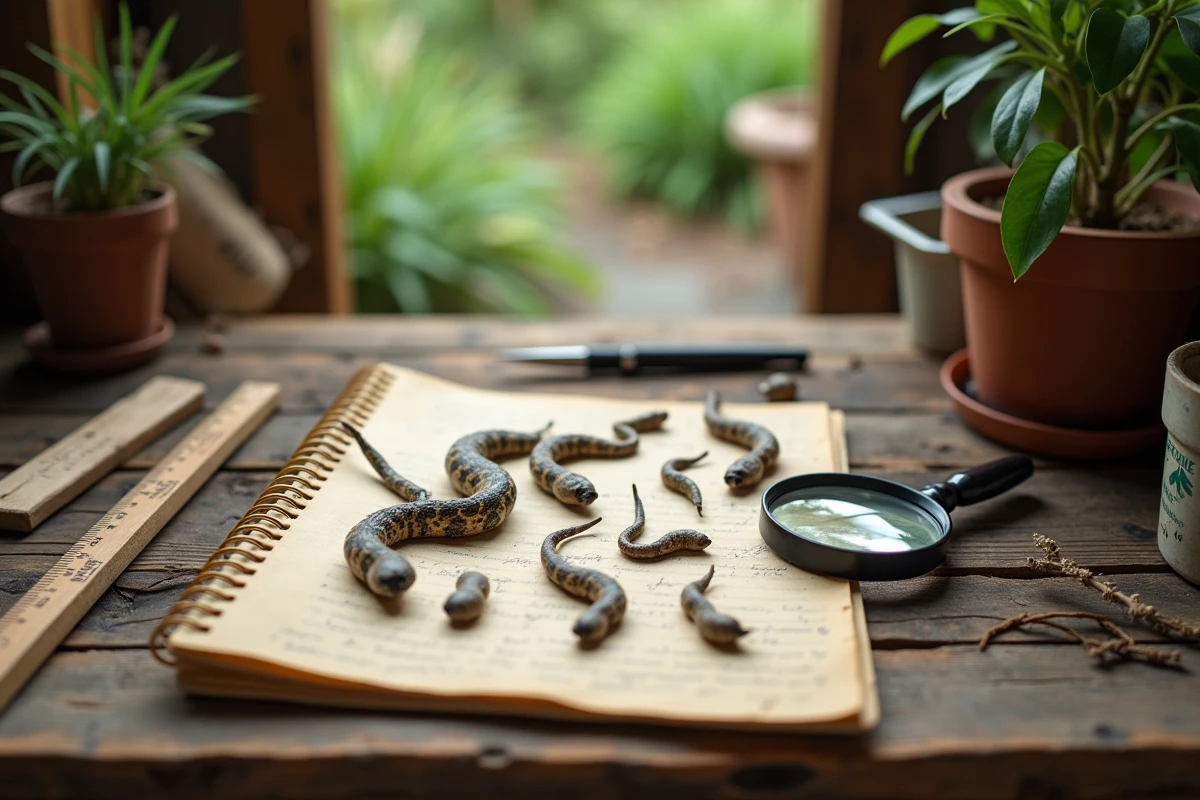
Grass snake or green and yellow snake: does the dropping change according to the species?
In mainland France, the two most common species in gardens are the grass snake and the green and yellow snake. The available data do not allow for a formal distinction of their droppings based solely on visual appearance. The size of the dropping mainly varies depending on the size of the snake and the prey ingested, not the species itself.
However, the diet differs. The grass snake primarily feeds on amphibians (frogs, newts), while the green and yellow snake consumes more lizards and small mammals. The content of the dropping can therefore indicate one species or the other: frog bone fragments point to the grass snake, while remains of lizard or voles point to the green and yellow snake.
This distinction remains indicative. Without direct observation of the snake, attributing a dropping to a specific species is more a matter of probability than certainty.
Snake droppings near the compost: what it reveals about your garden
Data from citizen science platforms like Faune-France and iNaturalist show a significant increase in reports of snakes in peri-urban areas since the early 2020s. This progression is correlated with the abundance of prey (rodents, amphibians) in gardens with water points, open composts, or dense vegetation areas.
Regularly finding snake droppings around a composter is not a sign of nuisance. Snakes are attracted there by the heat of decomposition (favorable for their thermoregulation) and by the rodents that colonize the compost. A snake established near a compost actively regulates the population of rats and mice, making it an effective ally.
Veterinary clinics and poison control centers also report an increase in consultations related to dogs that have ingested snake droppings. This risk remains low, but it justifies monitoring pets in areas where droppings are regularly observed.
Should snake droppings be cleaned up?
No health obligation requires it for a private garden. Snakes are protected species in France: killing, capturing, or destroying their habitat is prohibited. Removing their droppings has no impact on their presence, as they do not return to a site because of their own excrement.
If the droppings are found on a terrace or playground, a simple wash with water is sufficient. In the rest of the garden, leaving them in place poses no problem: they decompose in a few weeks and enrich the soil with nitrogen.

The presence of snake droppings in a garden indicates a functional ecosystem, with available prey and sufficient shelter. Before seeking to drive away these reptiles, observing the content of their droppings provides a direct insight into the food chain operating just a few meters from the house.