
A screwdriver that slips, a drill that’s too weak for a load-bearing wall, a saw gathering dust in the garage: choosing the right DIY tools is just as important to the success of a project as having the necessary skills. Before filling a toolbox, first consider how often you’ll actually use each tool and what materials are found in your home.
Buy, rent or repair: the real criteria for choosing your tools
Have you ever bought a tool, used it once and then forgotten about it at the back of a cupboard? That habit is costly and takes up unnecessary space.
For tools you use several times a year, such as a cordless drill/driver or jigsaw, buying makes sense. However, renting is often more cost-effective for specialist tools, such as a floor sander, professional heat gun or rotary hammer. Many DIY stores and online platforms offer daily rentals.
France’s AGEC law has also introduced a repair bonus for certain DIY and gardening items, through QualiRépar-certified repairers. Rather than buying a new drill when yours breaks down, replacing a faulty switch or chuck can extend its life by several years.
Comparing a repair quote with the price of a new tool is a useful habit, especially when you consider Bobo Le Brico’s equipment, which lets you browse the available ranges before making a decision.
France’s repairability index, which is mandatory for certain electrical and electronic equipment, can help you decide. It assesses how easy a product is to dismantle, whether spare parts are available and whether technical documentation can be accessed. Not all power tools are covered yet, so check the information for the specific model before buying.

Drills, saws and screwdrivers: put together a kit suited to your projects
Rather than drawing up an endless list, let’s focus on the three tools that cover most household tasks.
The cordless drill/driver
This should be your first purchase. It can drill, drive and remove screws in wood, thin metal and lightweight partition walls. For concrete or stone walls, you’ll need a hammer drill or rotary hammer, which brings us back to renting if you only need one occasionally.
Two factors really matter: torque, measured in newton-metres, and battery type. Higher torque makes it easier to work with hard materials. A lithium-ion battery charges quickly and doesn’t suffer from memory effect.
The right saw for the material
A hand saw is enough for occasional cuts in softwood. For curved cuts or cutting plywood, a jigsaw is a better choice. Here too, it depends on the project: there’s no need to invest in a circular saw just to put up two shelves.
A quality screwdriver set
A good screwdriver set is hard to replace with a poor-quality one. Choose a set with flat-head and cross-head (Phillips and Pozidriv) bits in several sizes. Magnetic bits help prevent screws from getting lost in awkward corners.
Dust and older materials: a frequently underestimated risk
Are you renovating a home built before the 1990s? Its materials may contain hazardous substances. INRS recommends identifying materials before starting any work, because a standard shop vacuum doesn’t filter out all hazardous dust.
The label “shop vacuum” doesn’t guarantee that a vacuum is suitable for every job. For wood dust, a model with an appropriate filter is enough. For potentially hazardous materials, such as old paint or suspect floor tiles, having a professional assess them first is the only reliable approach.
Some vacuums have a power tool outlet that automatically starts the vacuum when the connected tool is switched on. This is convenient, but you should also check that the connector fits and review the electrical limits stated in the manual.
- Check the vacuum’s filtration class against the material you’re working with (wood, plaster or older materials).
- Make sure the vacuum hose fits the power tool’s dust outlet.
- Check the manual for the maximum power supported by the tool-activated outlet.
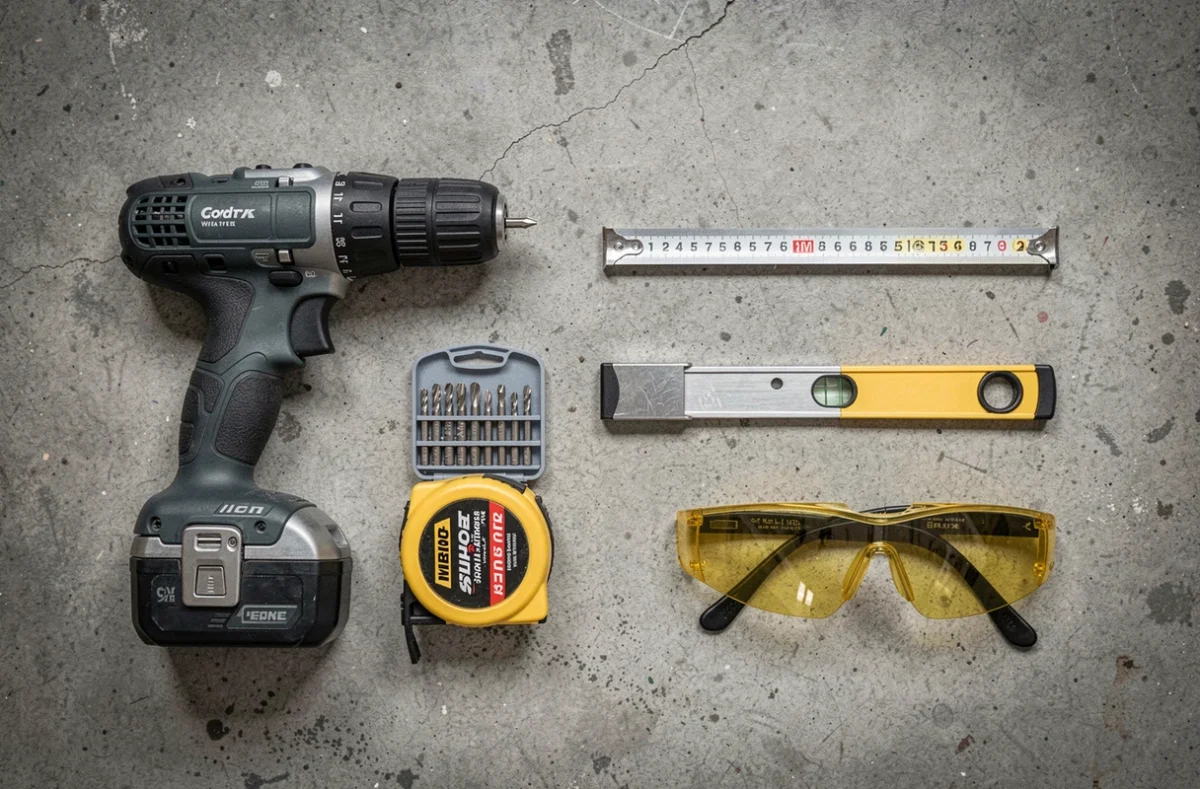
DIY safety equipment: what really protects you
Safety glasses and gloves are often treated as an afterthought. Yet they deserve just as much attention as the tools themselves.
Glasses with side arms don’t protect you from side impacts. For grinding or drilling into stone, wraparound safety glasses or a face shield are a better choice. Choose gloves to suit the task: cut-resistant gloves for cutting, and lightweight gloves for handling small parts.
Hearing protection matters too, especially when using a circular saw or rotary hammer. Earmuffs or custom-moulded earplugs reduce fatigue and protect your hearing over the long term.
- Wraparound safety glasses for drilling and grinding.
- Gloves suited to the task (cut-resistant, insulating or lightweight).
- Hearing protection whenever the tool is uncomfortably loud.
- A dust mask when sanding or cutting wood.
Store and organise your DIY workshop
A tidy workshop saves time and helps prevent accidents. The principle is simple: every tool has a designated place that you can reach without moving three boxes.
A wall-mounted pegboard is inexpensive and frees up workbench space. Hang hand tools on it by size. Store consumables such as screws, wall plugs and nails in clear compartment boxes so you can identify them without opening the boxes.
For power tools, their original cases are still the best storage option. They protect against knocks and keep accessories together. If space is limited, a metal shelving unit will support more weight than one made from particleboard.
The ideal DIY toolkit isn’t the most comprehensive one; it’s the one that suits the work your home actually needs. A focused, well-maintained kit, supplemented by rentals when a tool is only needed occasionally, covers most household tasks without taking up space or wasting money.