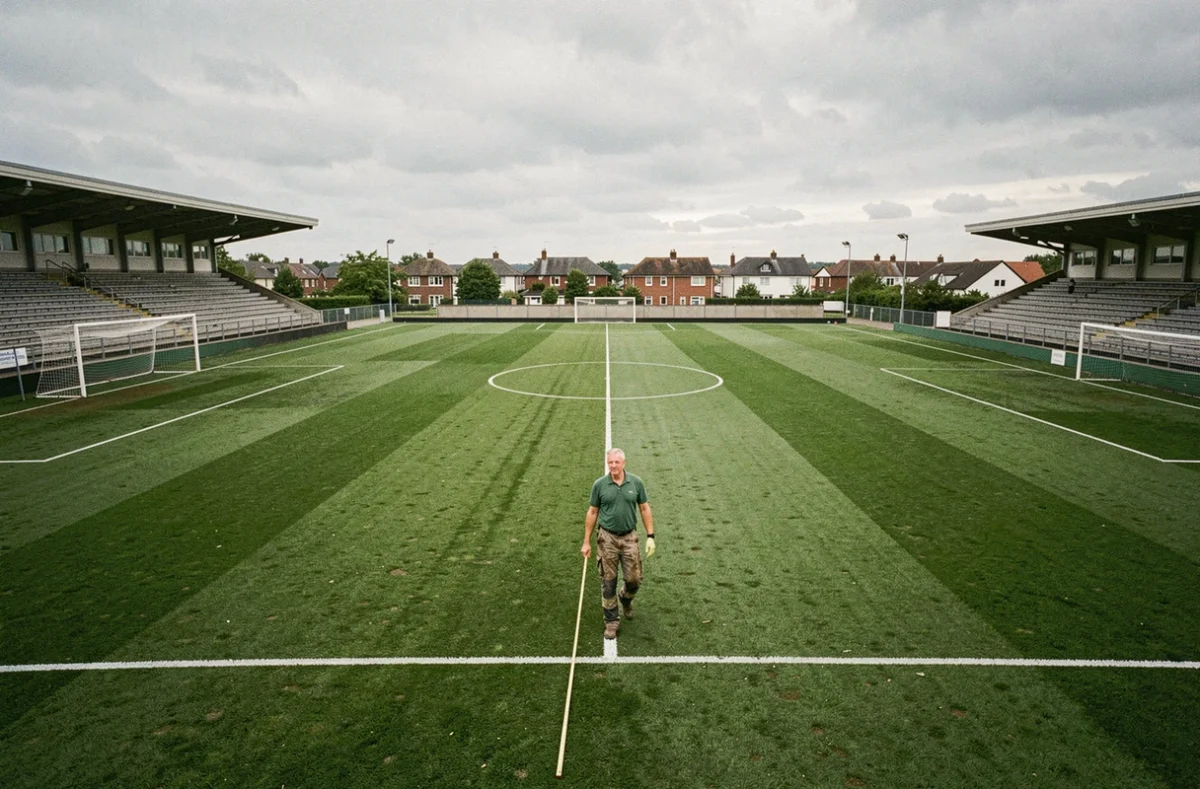
One hectare is 10,000 m². The figure is precise and easy to remember. But when it comes to picturing this area in space, most people instinctively think of a football pitch. The problem is that football pitches don’t have fixed dimensions. Depending on the format, the comparison can vary considerably.
Playing area or total footprint: two very different areas
When we say “a football pitch,” we usually mean the rectangle marked out by the white lines. That’s the playing area. But a complete sports facility extends beyond it.
Space must also be allowed around the rectangle for run-off areas, public walkways and, sometimes, stands, changing rooms or a car park. The total footprint of a football facility is much larger than the playing area. A municipal stadium and its surrounding grounds can take up two to three times the area of the pitch itself.
When a property developer or urban planner compares a plot of land to “a football pitch,” they almost always mean the playing area alone. It’s a convenient shorthand, but it’s worth knowing this to avoid confusion. To better understand the area of a football pitch in hectares, distinguishing between the playing area and the overall footprint is the first thing to keep in mind.
Football pitch dimensions: why there’s no single standard size
The IFAB Laws of the Game (the rules governing football) don’t prescribe a single pitch size. Instead, they set out a range of permitted dimensions.
- For ordinary matches, the pitch can be 90 to 120 m long and 45 to 90 m wide. A small pitch measures 4,050 m², while a large one measures 10,800 m².
- For international matches, the range is narrower: 100 to 110 m long and 64 to 75 m wide. Even so, the area can vary from 6,400 m² to 8,250 m².
- The most common format, found in most professional stadiums, measures 105 m long by 68 m wide, for a total area of 7,140 m².
This variation explains why there’s no single answer to the question, “How many football pitches fit into one hectare?” It all depends on which pitch you use as a reference.
Converting hectares to football pitches: figures by format
Let’s take the most common example. A 105 x 68 m pitch (7,140 m²) means that one hectare is equivalent to about 1.4 football pitches. Conversely, a single pitch covers about 0.71 hectares.
For an international match, depending on the combination of dimensions permitted by the IFAB, one hectare is equivalent to about 1.2 to 1.6 pitches. That’s a significant difference: the smallest and largest estimates are almost half a pitch apart.
A table to make things clear
| Pitch format | Dimensions | Area | Pitches per 1 ha |
|---|---|---|---|
| Minimum for ordinary matches | 90 x 45 m | 4,050 m² | 2.5 |
| Common format (professional) | 105 x 68 m | 7,140 m² | 1.4 |
| Maximum for ordinary matches | 120 x 90 m | 10,800 m² | 0.9 |
| Minimum for international matches | 100 x 64 m | 6,400 m² | 1.6 |
| Maximum for international matches | 110 x 75 m | 8,250 m² | 1.2 |
The table reveals something striking: a pitch at the maximum permitted dimensions is already larger than one hectare (10,800 m² compared with 10,000 m²). So the common belief that “one hectare is the size of a football pitch” is only true in some cases.

Visualising a hectare without a football pitch
A football pitch is the most popular comparison, but it’s not the only way to picture 10,000 m². Have you ever tried to imagine a perfect square measuring 100 m on each side?
Picture a city block in a densely built-up area. In many French city centres, a block covers an area comparable to one hectare, including its buildings and inner courtyard.
For agricultural land, the hectare remains the standard unit. A rectangular field measuring 200 m by 50 m, or 250 m by 40 m, is exactly one hectare. These elongated proportions are more representative of rural plots than a perfect square.
Conversion to m²: practical reference points
The conversion itself is simple. 1 hectare = 10,000 m². This relationship comes from the metric system: “hectare” literally means “one hundred ares,” and one are equals 100 m².
Here are a few useful equivalents to remember:
- 0.5 hectares = 5,000 m², or about 0.7 of a football pitch in the common format
- 1 hectare = 10,000 m², or about 1.4 pitches measuring 105 x 68 m
- 2 hectares = 20,000 m², or about 2.8 pitches in the same format
- 1 hectare = about 2.47 acres (an imperial unit still used in the United Kingdom and the United States)
The most common pitfall in these conversions is confusing ares, hectares and acres. The are (100 m²) and the hectare (10,000 m²) belong to the metric system. The acre (about 4,047 m²) comes from the imperial system. Mixing the two systems can lead to significant errors.
When someone tells you, “It’s about the size of a football pitch,” ask them which pitch. A minimum-size pitch is less than half a hectare, while a maximum-size pitch is larger than one hectare. The next time this comparison comes up in a conversation about a property development or an agricultural plot, you’ll know that the exact figure depends entirely on the format used—and that the usual comparison refers only to the playing area.