
A rarely revealed manufacturing secret: the rural America of Little House on the Prairie most often never saw the snow of Minnesota. The team filmed under the California sun, thousands of miles away from the landscapes evoked in the narration. And the adaptation process? It was reversed: the rights to the novels were only negotiated after the project started, shaking up the well-established practices of American television.
The young actors discovered an intense shooting rhythm, far from today’s protection standards. The scripts constantly oscillated between historical facts and inventions, continuously pushing the boundary between fidelity and fiction.
Why Little House on the Prairie continues to fascinate entire generations
What distinguishes Little House on the Prairie in the landscape of American television is its ability to blend simplicity, emotion, and depth. Inspired by the autobiographical account Pioneer Girl by Laura Ingalls, the series portrays the daily life of the Ingalls family: Charles, Caroline, Mary, Laura, Carrie, and the faithful Jack. Brought to the screen by Michael Landon and his partners, this family embodies a collective ideal: that of a rural America where solidarity, perseverance, and parental love serve as a bulwark against adversity.
Between 1974 and 1983, on NBC, the series established itself with its minimalist sets, its human and family values, and a largely romanticized vision of the Westward Expansion. This approach did not prevent the series from profoundly marking American popular culture. This writing, both attached to history and ready to reinvent it, allowed millions of viewers to see themselves in the Ingalls children or their courageous parents. Each episode reminds us of the harshness of an era while celebrating the warmth of a united home.
The representation of rural life, its landscapes, its challenges, still resonates with those who dream of authenticity, far from modern noise. Active communities perpetuate this enthusiasm: on lapetitemaisondanslaprairie.fr, one can find the spirit of Laura Ingalls Wilder adapted to today’s home, with advice, sharing, and exchanges around the art of living at home.
To better grasp what fuels this loyalty, here are some key points:
- Ingalls Family: the very model of the pioneering unit, tenacious and united
- Values conveyed: solidarity, courage, generational transmission
- Influence: the series still shapes the collective imagination of the American West
The filming secrets and little-known anecdotes that forged the unique atmosphere of the series
The unique atmosphere of Little House on the Prairie results from a multitude of precise choices and unwavering commitment from the team, both in front of and behind the camera. In Simi Valley, California, the sets were designed to reflect the robust simplicity of Midwest farms. Nothing was improvised: the Ingalls house, meticulously reconstructed, is directly inspired by the rural American reality of the late 19th century.
Some objects have become iconic: Charles Ingalls’ violin, much more than an accessory, embodies transmission and resilience in the face of adversity. We also find Charles’ pipe or Laura’s porcelain doll, symbols of a family and pioneering memory. Today, these relics, or their replicas, such as those made by Claire Vilani in Campénéac, remind us of the imprint left by the series in minds and homes.
The world of Little House on the Prairie has extended far beyond the small screen. Enthusiasts have established places entirely dedicated to the series, like the Claire Vilani Museum. Other projects are emerging: replicas of the Oleson grocery store, Nellie Oleson hotel-restaurant, objects collected from flea markets… Every detail aims to recapture the spirit of an era where conviviality and family epic shaped daily life. These places, accessible by reservation, testify to the lasting attachment to the Ingalls saga and what the series has managed to inscribe in collective memory.
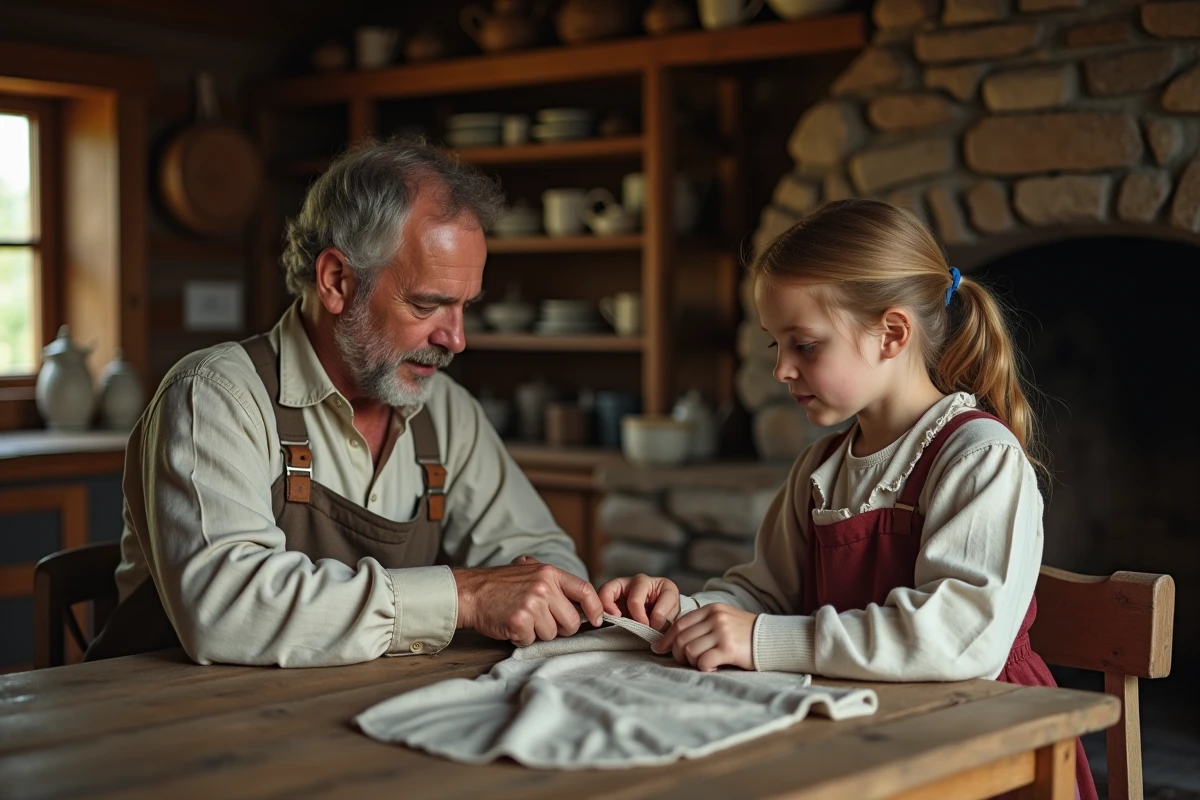
Between fiction and reality: what life in Walnut Grove still teaches us today
Little House on the Prairie, under its guise of an idealized rural America, echoes a foundational chapter in the country’s history. The autobiographical writings of Laura Ingalls Wilder trace the family’s migration from Wisconsin to Kansas and then to South Dakota, following the paths of the first settlers who set out to conquer new lands. This vast movement, made possible by the Homestead Act signed by Abraham Lincoln in 1862, pushed thousands of families to settle in the Great Plains. However, the series sometimes chooses to downplay the harshest aspects of this history.
To better understand this tension between reconstruction and myth, here are some realities to know:
- The log cabin, a structure imported by Swedish and Finnish settlers, stands as a symbol of pioneering identity, contrasting with the traditional habitat of indigenous peoples.
- In Walnut Grove, mutual aid and the ability to overcome challenges (drought, endless winters, threatened harvests) emerge as collective responses to the harshness of life.
- The series sidesteps certain dark aspects: colonial violence, racism, the difficulties faced by pioneers, and the dispossession of lands, particularly those of the Osage during the Ingalls’ arrival in Kansas.
The wooden houses, studied by James Mooney among the Cherokee Iroquois, remind us that the pioneering story is not just a sweet epic. Walnut Grove, beyond the sets, invites us to question the boundary between popular memory and the complex reality of westward expansion. Between myth and history, the series leaves the door open for reflection, or nostalgia, depending on where one chooses to look.